


Book launch Ancestral Territories: Urban Agriculture and Socio-biodiversity in the City of Sao Paulo
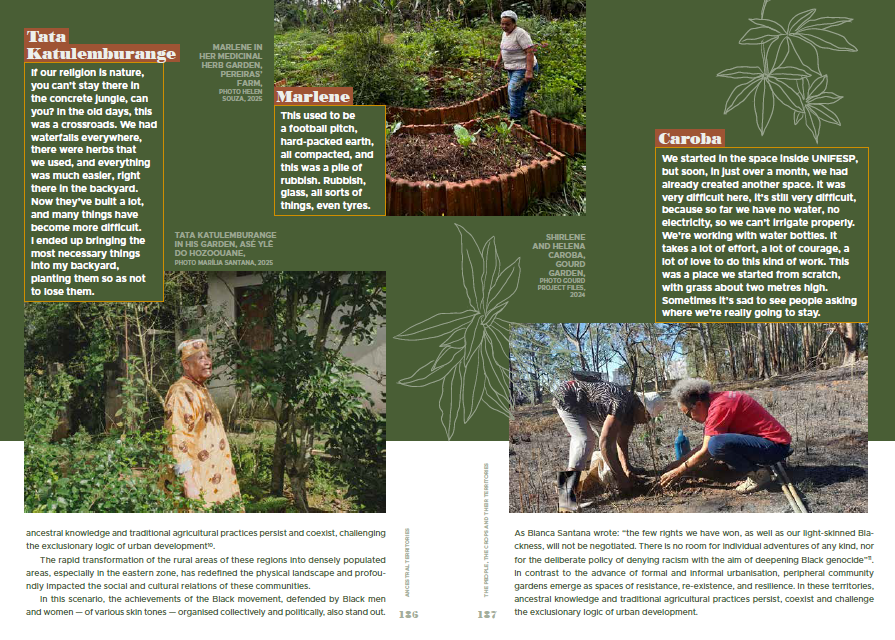
On May 28th 2026, the book Ancestral Territories: Urban Agriculture and Socio-biodiversity in the City of São Paulo was launched. It was written by farmers from 13 gardens and edited by Luciana F. Itikawa and Helen Evelin de Souza.The launch positioned the farmers as the protagonists of the knowledge contained in the book, rather than as research subjects. The event featured a beautiful performance by a group of musicians and a dancer led by Pai Marcelinho de Logun Edé, followed by panel discussions with the farmers, project collaborators and coordinators. The book recounts the stories of a journey driven by struggles and achievements, mostly by Black, Indigenous and Northeastern women in the city of São Paulo. Those present at the event included teachers, representatives of the public authorities and politicians committed to the agroecological agenda in the municipality. The book demonstrates the importance of recognising and valuing the practices that contribute to the maintenance of ecosystems and the preservation of the cultural, medicinal and spiritual practices of these communities. These are heritage assets that strengthen environmental preservation and the continued presence of these communities in their territories.
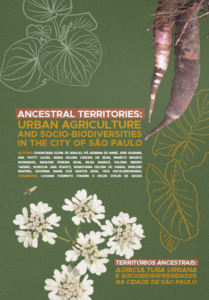
The book is the result of Brazil’s INSUAH project, based on the concept of Urban Agriculture as Cultural Heritage through “living laboratories” (LLs). Our LL research methodology is a co-production of knowledge with an immersive fireldwork that lasted two months at each garden, collective ethnobotany workshops, multistakeholder field trips to quilombo communities and Indigenous villages, interchange experiences among gardens, collective farming and management efforts, training on native creole seeds, participation in public policy negotiation forums, conference trips, fairs, and roundtable discussions—always involving women farmers, researchers, technicians, and managers. These gardens featured choices of plant species, processes, and cultivation methods that restore soils, promote biodiversity, and ensure healthy and accessible food, all derived from practices that value and preserve ancestral and traditional knowledge. Based on an agrobiodiversity inventory and a record of different management practices, cosmologies, and land-use systems, the research concluded that the legacy of indigenous peoples and traditional communities are important allies in local ecological conservation.
Besides immersive fieldwork and workshops, Team Brazil analyzed 1,311 vegetable gardens that are part of the municipal AUP program from climatic, urban, social and environmental perspectives. Maps were created showing the correlation between the 1,311 vegetable gardens and areas at risk of landslides and flooding, race/ethnicity, income, environmental conservation areas, and the geographic distribution of production units, among other factors.
One of the spatial analysis assesses gardens’ contribution to climate change mitigation. This analysis of a 40-year historical time series, spanning 1985 to 2024, demonstrated that there is a temperature difference ranging from 6.4°C to 7.4°C over the four decades between the vegetable gardens and the average temperature of the urban fabric of the São Paulo Metropolitan Region (RMSP). In the last decade (2015–2024), there was a difference of up to 7.01°C, a finding that allowed for an analysis of how the thermoclimatic influence of these spaces is of extremely high local relevance. In other words, the peripheral urban gardens studied—which produce food and maintain ties to traditional farming practices—provide significant vegetation cover in an urban setting to maintain the climate within the garden.
Vegetable gardens are, by definition, spaces that contribute to the processes of evaporation, transpiration, condensation, precipitation, and surface runoff; therefore, their presence in both small- and large-scale urban areas is crucial for the microclimate. Since the water cycle has accelerated in recent decades—with rising temperatures and increased rainfall—spaces that can help cool temperatures and absorb water must be valued.
The choice of race, gender, and location as analytical frameworks was made to examine urban agriculture and compelling examples of ancestral knowledge in the city’s periphery. Peripheral vegetable gardens remnants of the green belt of the still-rural city have been encircled by urbanization processes and persist as repositories of immense biodiversity, sustainable knowledge, and forms of community organization, as well as underutilized spaces where urban agriculture takes root through agroecological management practices. However, there are still factors that hinder this activity, whether due to insecurity of tenure; growing vulnerability to the effects of global warming; or the degradation of the spaces these people inhabit in the form of precarious urban infrastructure especially environmental sanitation which reveals yet another form of silent violence that impacts both the body and the territory. The book written by the women farmers is yet another tool that should be used as a reference for formulating public policies to address the challenges presented.
Credits:
Authors and Farm leaders from the surveyed vegetable gardens: Ara Yvoty Laura, Guaraciaba Elena de Araujo, Iyá Adriana de Nanã, Jerá Guarani, Mametu Mhuato Monamaze, Maria Helena Caroba da Silva, Marlene Pereira Silva, Nilda Saragó, Paloma Ribeiro Tarrão, Roseilda Lima Duarte, Sebastiana Helena de Farias, Severina Maria dos Santos Silva, Shirlene Martins, Tata Katulemburange.
Project team and authors/editors of the publication: Luciana Fukimoto Itikawa and Helen Evelin de Souza.
Researchers who contributed to the fieldwork: Juliana Mangaba de Oliveira, Fernanda Durazzo Oliveira, Flávia Ferreira Alves, Marília Simões and Juliana Neumann.
Institutional support: Prof. Humberto Rocha (IAG-USP), Prof. Antonio Saraiva (IEA-USP), Prof. Renato Cymbalista (FAU-USP), USP Foundation (FUSP), USP Institute for Advanced Studies (IEA-USP).
Funding: Volkswagen Foundation.


